What is Ashtanga yoga? A guide for first-timers
Ashtanga is the practice that now opens most of our days at Basecamp. It has a reputation for being strong and disciplined, and it is, but it is also one of the most welcoming styles to learn, because the shape of the practice never changes. Here is what it is, where it comes from and what to expect when you join us at 8:00.
Where Ashtanga comes from
Ashtanga, often called Ashtanga Vinyasa yoga, was popularised by K. Pattabhi Jois, who opened his yoga institute in Mysore, in southern India, in 1948. Jois said he learned the method from his teacher, Tirumalai Krishnamacharya, whose dynamic, flowing approach also shaped much of the yoga practised around the world today.
Students began travelling to Mysore to practise with Jois from the 1960s onwards, and the method spread from there. His grandson, R. Sharath Jois, later carried the tradition on in Mysore. Anna, one of this season’s teachers at Basecamp, studied there with Sharath after years of daily practice, and her classes are rooted in that tradition.
The same sequence, every time
What makes Ashtanga different from most other classes is that the order of postures is fixed. Every practice begins with sun salutations, five rounds each of Surya Namaskara A and B, then moves through a standing sequence, into the seated postures of a series and finally a calm closing sequence and rest.
The first series, known as the Primary Series or Yoga Chikitsa, is the one almost everyone practises. There are further series beyond it, but they are for people who have practised for years. Because the sequence repeats, you stop wondering what comes next and start noticing how your body and breath change from day to day. Progress in Ashtanga is very easy to feel.
Breath, bandhas and gaze
Ashtanga teachers talk about tristhana, three things you attend to at once: the breath, the posture and the drishti, or gazing point. Each movement is linked to an inhale or an exhale, and postures are usually held for around five breaths. The breath is steady and audible, which gives the room a rhythm all of its own.
You will also hear about bandhas, gentle engagements of the pelvic floor and lower belly that help you feel light and supported. And each posture has a set place to rest your eyes, such as the tip of the nose or the thumbs. It sounds like a lot to hold in mind, but it quickly becomes a way of keeping your attention on the mat instead of on the view (which, in our shala, is quite a challenge).
Led classes and Mysore style
There are two traditional ways to practise. In a led class, the teacher counts the whole group through the sequence together, breath by breath. In a Mysore-style class, each student moves through the sequence at their own pace while the teacher goes around the room giving individual help and adjustments. Both are part of the tradition, and many people practise a mix of the two.
Is Ashtanga suitable for beginners?
Yes. Nobody is expected to arrive able to do every posture. A good teacher will offer simpler versions, suggest props and let you stop where it makes sense for your body that day. Many people practise only part of the Primary Series for a long time, and that is exactly how the method is meant to grow.
What helps most is coming back. Ashtanga rewards repetition, which is why it suits a stay of a week or more so well: by your third or fourth morning the sequence starts to feel familiar, and you can relax into it.
Ashtanga at Basecamp
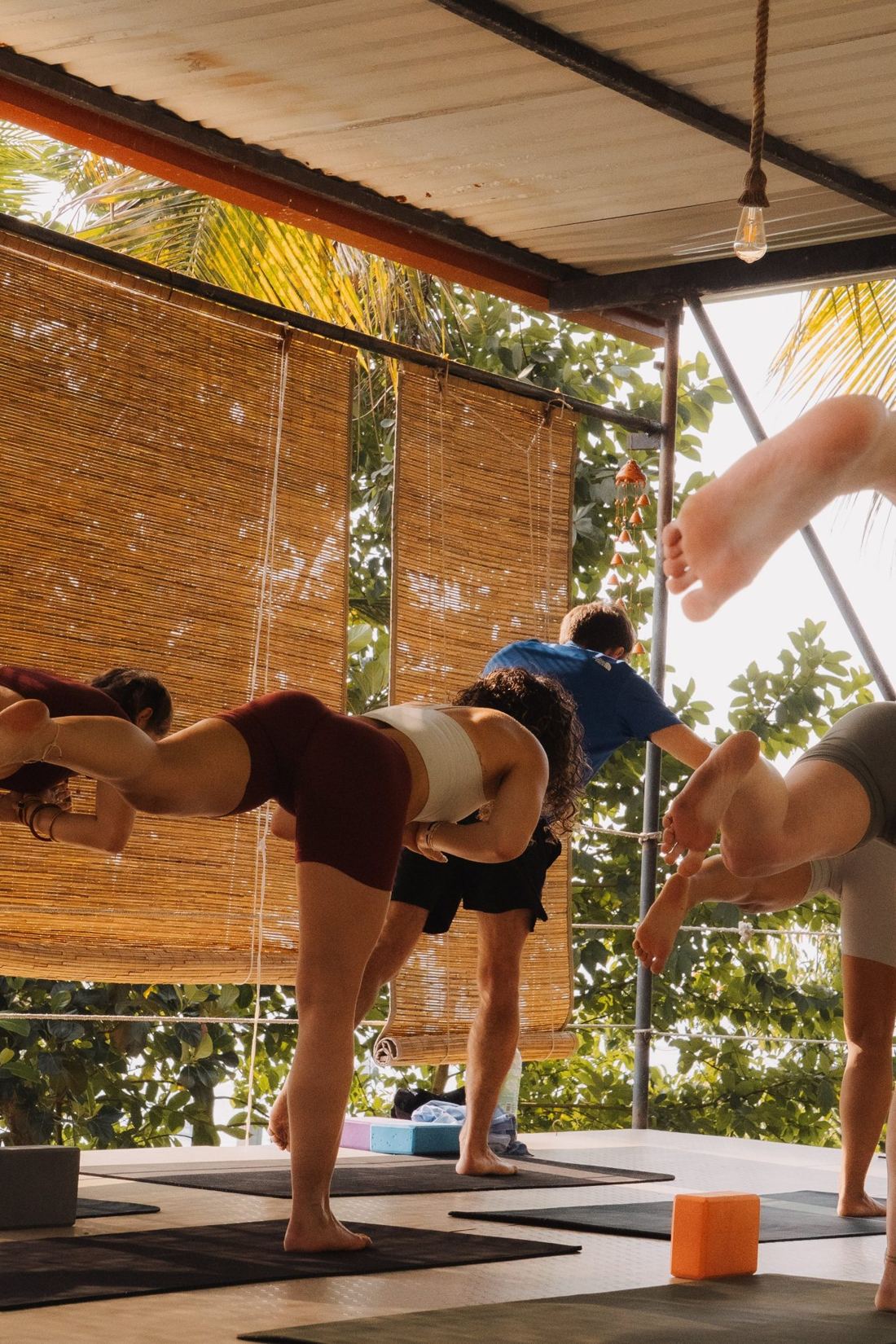
For now, Ashtanga has taken over most of our 8:00 morning classes, with Vinyasa on some mornings depending on who is teaching. Classes last 75 minutes, are open to all levels, and take place in our thatched shala above Weligama harbour. Mats, blocks and props are provided. Anna’s teaching includes careful hands-on adjustments that honour each student’s boundaries.
After practice there is breakfast at the long table, and at 16:30 the day closes with slow, deep Yin yoga, a lovely counterbalance to a strong morning. If you prefer a freer, more creative flow, read our guide to Vinyasa yoga. Not staying with us? You can join any class as a drop-in, and you can see the full timetable and teachers on our yoga page.
Come and stay with us
Pick your dates and room, and the yoga and breakfast are already included.
More guides: A yoga retreat in Weligama · Yoga and surf in Weligama · All guides